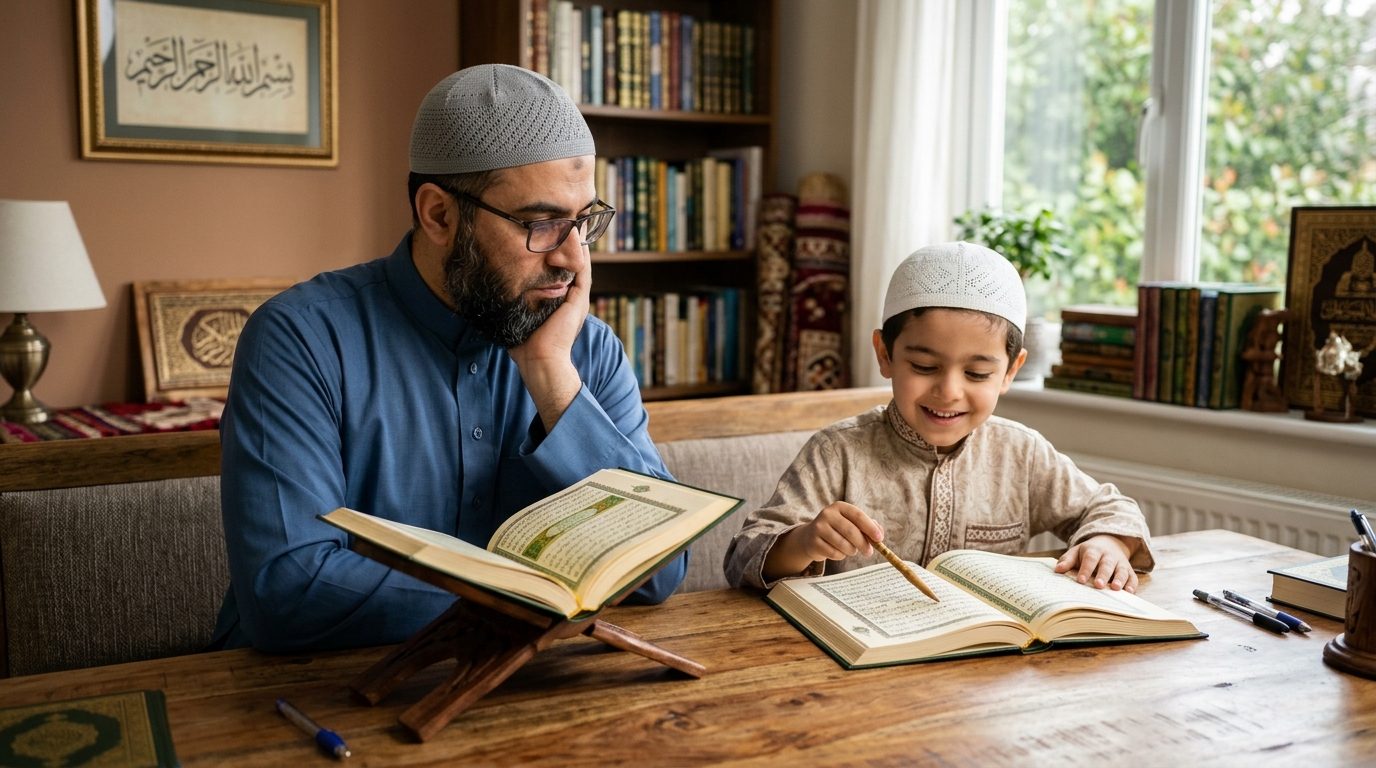
Allah SWT assures humanity in Surah Al-Qamar that the Holy Quran has been made easy for all seekers. Yet, how a 6-year-old child absorbs Arabic phonetics differs dramatically from how a 45-year-old working professional or adult revert processes the divine text. When educational institutions apply a rigid, one-size-fits-all child pedagogy to adult learners, adults often feel patronized, embarrassed, or discouraged. Understanding the distinct psychological, neurological, and scheduling realities of both demographics is essential for lifelong Quranic success.
1. Phonetic Plasticity vs. Analytical Understanding
The child brain possesses exceptional neuroplasticity. Children absorb unfamiliar Arabic articulation points (such as the throat letters ح, ع or emphatic letters ص, ض) through sheer acoustic imitation, without needing anatomical explanations.Adults, by contrast, possess fixed vocal habits built over decades of speaking English or other mother tongues. An adult cannot simply 'repeat after the teacher'; they benefit immensely from understanding the Makhraj anatomy: where the tongue touches the upper palate, how the vocal cords vibrate, and why acoustic airflows differ.
2. Comparative Overview: Kids vs. Adult Quran Learning
The following table contrasts the key pedagogical differences between teaching young children and teaching adults:| Dimension | Children (Ages 4–12) | Adults (18+ & Reverts) |
|---|---|---|
| Primary Motivation | Parental guidance, fun games, praise, star stickers | Spiritual thirst, seeking forgiveness, prayer validity |
| Learning Method | Auditory repetition, visual Qaida slides, songs | Grammar rules, phonetic diagrams, word meaning |
| Main Hurdle | Short attention spans, restless physical energy | Self-consciousness, fear of making mistakes, busy jobs |
| Class Format | 25–30 min interactive micro-lessons | 40–50 min private 1-on-1 flexible evening slots |
3. The Psychological Barrier: Overcoming Adult Embarrassment
The biggest obstacle holding adult Muslims back from learning to read the Quran is not lack of intelligence; it is shame. Adults feel embarrassed sitting in front of a young Qari or admitting they cannot read Arabic at age thirty or forty."The one who is proficient in the recitation of the Quran will be with the noble and obedient scribes (angels), and he who recites the Quran and falters therein, and finds it difficult, will have a DOUBLE reward."
— Sahih Muslim 7984. Why Adults Flourish with Translation & Tafseer Integration
While children are content learning sounds and memorizing short Surahs for Salah, adults yearn for meaning. When an adult understands why an Ayah was revealed and what Allah is commanding, their motivation soars.Pairing basic reading drills with our Quran Translation & Tafseer Course turns what could be a dry mechanical exercise into an emotionally transformative spiritual awakening.
Cognitive Comparison: Kids vs Adults Quran Pedagogy Matrix
Understanding the distinct cognitive strengths of children versus adults allows educators to tailor instruction for maximum retention:| Pedagogical Factor | Children (Ages 4–14) | Adults (Ages 18+) |
|---|---|---|
| Primary Learning Mechanism | Sensory imitation & auditory repetition | Analytical rules & conceptual understanding |
| Phonetic Articulation (Makharij) | Absorbed naturally without conscious accent struggle | Requires deliberate anatomy study of tongue & throat |
| Optimal Lesson Duration | 30 minutes (high-energy, gamified pace) | 45 to 60 minutes (focused analysis & Tadabbur) |
| Primary Motivation Barrier | Short attention span & digital distractions | Self-doubt, busy work schedules & fear of mistakes |
Overcoming the Adult 'Pronunciation Self-Consciousness' Barrier
The single greatest obstacle preventing adults from learning Quran is not lack of intellect; it is adult self-consciousness. While a 6-year-old will happily repeat an Arabic letter ten times without hesitation, adult professionals often feel embarrassed making awkward sounds when practicing guttural letters like Qaf (ق) or Dhad (ض).Prophet Muhammad ﷺ addressed this exact anxiety with profound psychological reassurance:
"The one who recites the Quran proficiently will be with the noble, righteous angel scribes. And the one who recites the Quran with difficulty, stammering or stumbling through its verses, will receive a double reward!"
— Prophet Muhammad ﷺ (Sahih al-Bukhari 4937, Sahih Muslim 798)Frequently Asked Questions
Q: Can an adult learn to read the Quran fluently from scratch?
A: Yes, absolutely! Thousands of adult professionals and reverts start with zero Arabic knowledge and learn to read fluently within 4 to 6 months with 1-on-1 private tutoring.
Q: Is it harder for adults to learn Tajweed than children?
A: While children acquire phonetics more naturally, adults grasp the analytical logic and rules of Tajweed (such as Ikhfa and Idgham) much faster than children.
Q: Are female teachers available for adult sisters?
A: Yes. Jamia Quran Academy provides certified Alimahs and Hafizahs for adult sisters, ensuring complete comfort, privacy, and flexibility.
Q: Can an adult who doesn't know a single Arabic letter learn to recite Quran fluently?
A: Absolutely. Over 60% of our adult students begin with zero prior Arabic knowledge. Through our tailored adult Noorani Qaida course, adults master alphabet recognition, vowel marks, and fluent word-joining within 8 to 12 weeks of 1-on-1 tutoring.
Q: Should a working parent study Quran at the same time as their child?
A: Yes! While lessons should be separate 1-on-1 sessions suited to their respective learning styles, having a designated family Quran time where both parent and child do their daily homework side-by-side creates immense motivational synergy.
Jamia Quran Academy Scholarly Council
Authored and reviewed by certified Islamic educators and Ijazah-bearing Qaris at Jamia Quran Academy. Committed to spreading pure Quranic literacy, Tajweed, and character-building worldwide.
Begin Your Quranic Journey Today
Experience authentic 1-on-1 online classes tailored for children and adults. Start with 3 days of completely free evaluation sessions with our certified tutors.