How to Get an Authentic Quran Ijazah Online: Sanad Requirements and Process
Explore the rigorous criteria, oral Khatm standards, classical didactic poems, and unbroken lineage of transmitters connecting your voice directly to Prophet Muhammad PBUH through accredited online scholarship.
Quick Verdict: What It Takes to Earn a Legitimate Quran Ijazah
An authentic Ijazah is not a certificate of attendance; it is an irrevocable scholarly trust (Amanah). To qualify and complete an Ijazah online:
- Prerequisite: Impeccable recitation in Hafs 'an 'Asim with complete practical application of Tajweed rules and zero Lahn Jali (major errors).
- Requirement 1: Reciting the entire Quran (all 114 Surahs, 30 Juz) from beginning to end in private 1-on-1 sessions directly to an authorized Shaykh.
- Requirement 2: Mastering classical theoretical texts (Matn Al-Jazariyyah or Tuhfat al-Atfal) and defending rules with poetic evidence.
- Requirement 3: Passing a rigorous oral viva on Waqf, Ibtida, and Shariah ethics of Quran transmission before an academic supervisory committee.
Ready to begin? Audition directly with our senior Al-Azhar faculty through the Online Ijazah Program with Sanad Muttasil.
The Sacred Concept of Sanad Muttasil in Islam
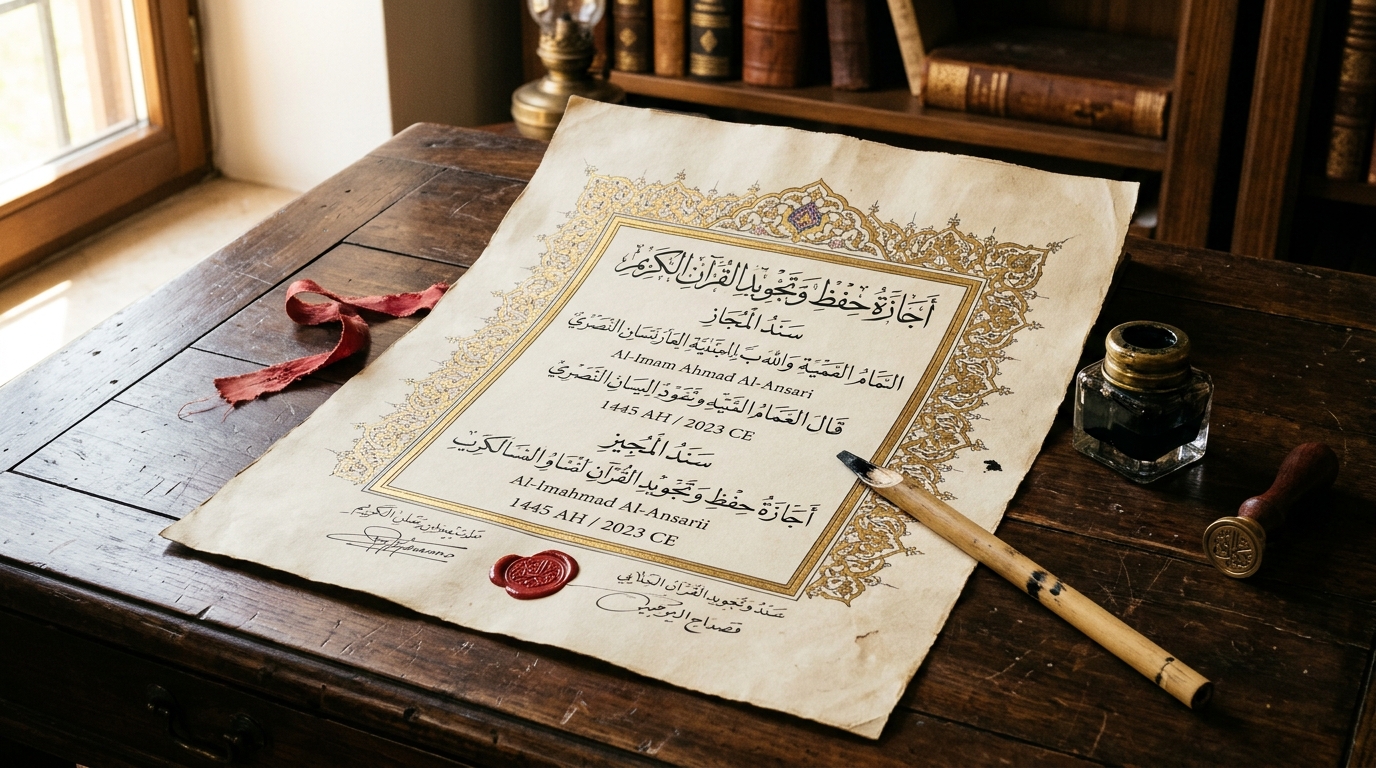
The Arabic term Ijazah literally means permission, authorization, or license. In Quranic terminology, it refers specifically to an official decree issued by an authorized master confirming that a student has mastered the recitation of the Holy Quran and is now licensed to teach and transmit it with an unbroken genealogical chain (Sanad Muttasil) reaching back to the Prophet Muhammad PBUH.
When you read the text of an authentic Ijazah parchment, you observe a breathtaking historical continuum: your instructor names their teacher, who names their teacher, traversing backwards through titans of Islamic scholarship like Imam Ibn al-Jazari, Imam al-Shatibi, Imam Asim, Abdullah ibn Mas'ud, Ali ibn Abi Talib, Uthman ibn Affan, the Prophet Muhammad PBUH, the Angel Jibreel, and the Divine Lord of the Heavens and Earth.
The Four Progressive Stages of the Online Ijazah Journey
Achieving this honored milestone follows a strict academic trajectory:
Stage 1: Preliminary Diagnostic Audition
The candidate reads selected passages (often from Surah Al-Baqarah, Surah Hud, and Juz Amma) before a senior Shaykh. The examiner assesses articulation, breath control, and ensures no lingering hidden defects before admitting the candidate into the formal Khatm.
Stage 2: Theoretical Mastery of Classical Matn
The student memorizes and dissects Matn Al-Jazariyyah, learning to cite exact lines of poetry as authoritative proof for articulatory traits, letter rules, and the nuances of Waqf and Ibtida.
Stage 3: The Complete Live Oral Khatm
Reciting all 6,236 verses of the Quran word by word in 1-on-1 private video sessions. Every slight deviation is corrected live, building extraordinary vocal stamina and mental sharpness.
Stage 4: Shariah Viva and Sanad Conferral
A concluding oral examination assessing teaching competency, ethical responsibilities, and Islamic manners, culminating in the ceremonial signing and sealing of the official Ijazah parchment.
Understanding the Transmission Routes: Shatibiyyah vs. Tayyibah
When pursuing an Ijazah in the narration of Hafs 'an 'Asim, candidates choose between two canonical routes:
- Tariq al-Shatibiyyah: The most widely recited route across the modern Islamic world. It requires holding Madd Munfasil (separated prolongation) strictly for four or five vowel counts and prohibits shortening it to two counts.
- Tariq al-Tayyibah: Documented by Imam Ibn al-Jazari in Tayyibat al-Nashr. It permits Qasr al-Munfasil (shortening separated Madd to two vowel counts), but enforces specific paired conditions on Takbeer between Surahs, Saktah locations, and vowel merges.
- Mastering both routes gives the licensed teacher total clarity when guiding students across different regional recitation conventions.
The Sacred Covenant and Adab of the Ijazah Holder
An Ijazah is not merely an intellectual qualification; it is a spiritual transformation. Classical masters refused authorization to anyone displaying arrogance, commercial greed, or negligence of Islamic worship. The recipient commits to maintaining daily recitation, embodying prophetic manners, treating students with boundless patience, and never concealing sacred knowledge from sincere seekers.
Comparing Ijazah Certification Tracks
Depending on your memorization status and academic ambitions, choose the appropriate authorization track:
Are You Ready for the Ijazah Track? Candidate Self-Audit
Before applying for an audition, reflect on these essential readiness indicators:
Phonetic Readiness
Can you consistently distinguish subtle heavy and light letters (Taa vs Taa, Dhal vs Zha) without conscious pauses or second-guessing?
Time Commitment
Can you dedicate at least 3 to 4 hours weekly to live recitation sessions plus 5 hours of private daily revision over the next 6 to 12 months?
Humble Receptivity
Are you prepared to have your pronunciation audited critically and repeat lines patiently until your recitation meets the scholar's standard?
Connect Your Recitation to the Prophet's Lineage
Begin the noble journey that will preserve your legacy across generations. Book your complimentary diagnostic audition with an Al-Azhar Grand Shaykh today.
Frequently Asked Questions About Quran Ijazah Online
Can an authentic Ijazah truly be earned online?
Yes. Leading contemporary Islamic bodies, including Al-Azhar University and traditional Qiraat councils, accept online Ijazah transmission provided the candidate completes a live, continuous 1-on-1 audio-visual Khatm directly before an authorized Shaykh.
What is the difference between an Ijazah in Recitation and an Ijazah in Hifz?
An Ijazah in Tilawat (Recitation) certifies reading the entire Quran from the printed Mushaf with flawless Tajweed, whereas an Ijazah in Hifz requires reciting the complete Quran entirely from memory without looking.
What texts must a candidate memorize for an Ijazah?
Most academic authorities require memorization and comprehension of either Tuhfat al-Atfal (for intermediate students) or Matn Al-Jazariyyah (for advanced reciters and teachers).
How long does the entire online Ijazah process usually take?
For a qualified candidate reading 3 to 5 pages per session across 3 to 4 classes weekly, completing the full Khatm and passing the theoretical viva typically requires 6 to 12 months.
Are female scholars available for female candidates seeking an Ijazah?
Yes. Jamia Quran Academy features licensed female Shaykhat who hold high Sanad chains and provide comprehensive 1-on-1 Ijazah auditing exclusively for sisters.
How do I schedule an initial audition to test my eligibility?
You can request a complimentary 3-day evaluation trial on WhatsApp with a senior Al-Azhar grand scholar to determine whether you are ready to begin the official Khatmat al-Ijazah.