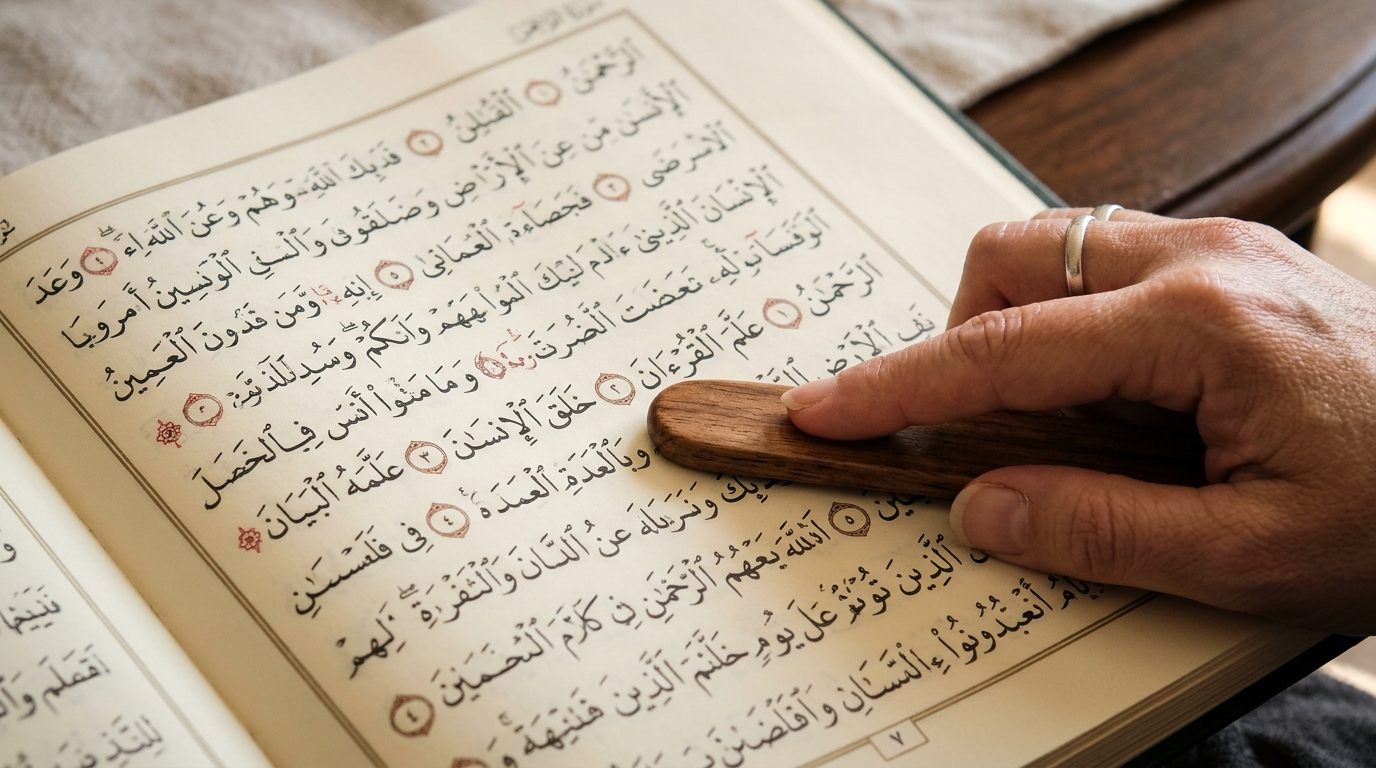
If you have never opened an Arabic book before, looking at the Holy Quran can feel intimidating. The flowing cursive script, unfamiliar diacritical marks above and below letters, and the fact that Arabic reads from right to left can make absolute beginners feel that Quran reading is an unattainable summit. Yet millions of non-Arabic speakers—including young children and adult converts—master reading the Quran every single year. By following a clear, structured roadmap, anyone can learn to read the Quran within a few short months.
Step 1: Master the 28 Arabic Letters in Isolation
Arabic has 28 letters. Your first goal is recognizing each letter's unique sound and shape from right to left:- Visual Dots (Nuqat): Notice how the letters ب (Baa), ت (Taa), and ث (Thaa) share the exact same boat shape, differing only by the placement of dots (one below, two above, three above).
- Unique Phonetics: Learn to produce the Arabic guttural and throat sounds (خ, ح, ع, غ, ق) through 1-on-1 repetition with a teacher.
Step 2: Learn How Arabic Letters Join Together
Unlike English printing where letters remain detached (C - A - T), Arabic letters connect to form words:Most letters change their appearance depending on whether they sit at the beginning, middle, or end of a word. In our Noorani Qaida Course, students practice joint letter identification drills until recognition becomes second nature.
Step 3: Understand the 3 Short Vowels (Harakat)
In Arabic, consonants are given vocal life through small symbols placed above or below letters:The 3 Primary Vowels of the Quran
- Fatha ( َ ): A small diagonal line above a letter, making the 'A' or 'ah' sound (e.g., بَ = Ba).
- Kasra ( ِ ): A small diagonal line below a letter, making the 'E' or 'ee' sound (e.g., بِ = Bi).
- Damma ( ُ ): A small curl resembling a comma above a letter, making the 'U' or 'oo' sound (e.g., بُ = Bu).
Step 4: Decode Your First Quranic Word
Once you combine consonants with Harakat, you can read your very first Arabic word!For example, take the letters ك (Ka), ت (Ta), and ب (Ba) with Fatha: كَتَبَ (Ka-Ta-Ba), meaning 'He wrote'. By reading syllables aloud in 1-on-1 lessons, your reading speed compounds week after week.
The 4-Stage Beginner Roadmap to Total Fluency
If you are starting from zero, the prospect of reading a 600-page Arabic Mushaf can feel overwhelming. Following a structured 4-stage roadmap breaks the journey into achievable, confidence-building milestones:Stage 1: Arabic Letter Recognition & Sound Isolation (Weeks 1–4)
Learn all 29 Arabic consonants. Focus on distinguishing look-alike letters through their dot placement (e.g. Baa ب, Taa ت, Thaa ث) and mastering unfamiliar throat sounds.
Stage 2: Short & Long Vowels (Harakaat & Madd) (Weeks 5–8)
Learn how Fatha (ah), Kasra (ee), and Damma (oo) give voice to consonants. Practice combining letters into 2-letter and 3-letter words.
Stage 3: Silent Letters, Tanween & Doubled Consonants (Weeks 9–12)
Master the resting Sukoon symbol, the doubling Tashdeed mark, and the Tanween double vowels. Practice reading full sentences from the Noorani Qaida primer.
Stage 4: Transition to Juz Amma (Weeks 13+)
Open the Mushaf to Surah Al-Fatiha and the short chapters of the 30th Juz. Read aloud word-by-word with an Ijazah tutor correcting errors in real time.
Overcoming Common Adult Beginner Anxieties
Adult learners frequently battle internal self-doubt that children never experience:- 'I am too old to start learning Arabic': The human brain retains neuroplasticity throughout life. In fact, adult learners often grasp abstract phonetic rules much faster than children because of mature cognitive discipline.
- 'My heavy English/Western accent will ruin the recitation': Every native English speaker begins with an accent. With gentle guided repetition under an experienced Qari, your throat muscles naturally adapt within weeks.
- 'What if I make a sinful mistake while reading?': In Islamic jurisprudence, a beginner who is actively learning and makes unintentional errors while striving to improve is not sinning—they are rewarded doubly for their effort and humility!
Frequently Asked Questions
Q: How long does it take an adult beginner to read the Quran?
A: Most adult beginners with zero prior knowledge can read full Quranic verses smoothly within 3 to 5 months of taking 2 to 3 classes per week.
Q: Should I learn to speak Arabic before learning to read the Quran?
A: No. Quranic reading (decoding the script and Tajweed) is learned first. Understanding spoken Arabic or grammar can be pursued later.
Q: Should a beginner start reading directly from Surah Al-Baqarah (Page 2)?
A: No. Beginners should always begin with Surah Al-Fatiha, then move to the very end of the Quran (Surah An-Nas, Al-Falaq, Al-Ikhlas) where the Ayahs are short, rhythmic, and familiar from daily prayer.
Q: How many hours of practice per week does a beginner need to see real progress?
A: Just 2.5 to 3 hours total per week (3 classes of 30 minutes, plus 15 minutes of daily home review) produces remarkable reading fluency within 3 to 4 months.
Jamia Quran Academy Scholarly Council
Authored and reviewed by certified Islamic educators and Ijazah-bearing Qaris at Jamia Quran Academy. Committed to spreading pure Quranic literacy, Tajweed, and character-building worldwide.
Begin Your Quranic Journey Today
Experience authentic 1-on-1 online classes tailored for children and adults. Start with 3 days of completely free evaluation sessions with our certified tutors.