When non-Arabic speakers look at the Holy Quran, they see complex Arabic script with unfamiliar dots, curves, and diacritical marks. How does an absolute beginner bridge the chasm from being unable to recognize a single letter to reciting multi-verse Surahs with fluent Tajweed? The answer across the Muslim world for over a century has been Noorani Qaida. Far from being a simple primer, Noorani Qaida is a masterclass in educational phonology and graduated cognitive instruction.
1. The 17-Chapter Pedagogical Hierarchy
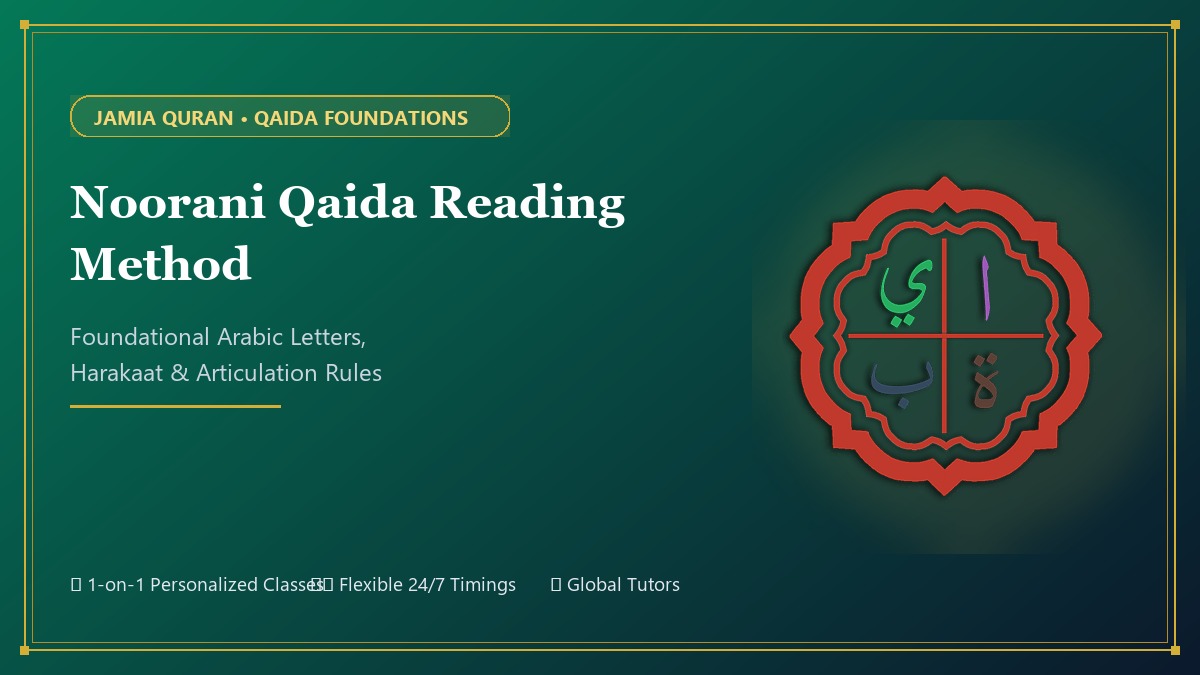
The brilliance of Noorani Qaida lies in its refusal to introduce two new concepts simultaneously. Every chapter builds mathematically upon the preceding lesson:The 4 Core Quadrants of Noorani Qaida
- Chapters 1–3 (Visual Alphabet): Single letters, composite ligatures, and detached letters (Huruf Muqatta'at).
- Chapters 4–6 (Vowel Mechanics): Short vowels (Fatha, Damma, Kasra) and Tanween (double vowels).
- Chapters 7–10 (Elongation & Stillness): Standing vowels, soft Leen diphthongs, and Sukoon (absence of vowel).
- Chapters 11–17 (Advanced Dynamics): Tashdeed (gemination/emphasis), Madd rules, and silent letters.
2. Why Skipping Qaida Causes Lifelong Stumbling
Some well-meaning tutors attempt to speed up learning by moving beginners directly into Juz Amma with English transliteration. This is disastrous:English transliteration cannot capture the difference between ح (throat H) and هـ (chest H), or ت (flat T) and ط (heavy T). Students who rely on transliteration develop incorrect phonetics that corrupt the divine text.
A rigorous foundation in Noorani Qaida prevents transliteration dependence permanently.3. Suitable for Both 5-Year-Olds and 60-Year-Old Reverts
Because Noorani Qaida is purely phonetic, it works across all age demographics. At Jamia Quran Academy, our tutors adapt the delivery: colorful gamified engagement for children, and respectful phonetic linguistics for adult learners and reverts.The 'Mirror Drill': Neuromuscular Training for Non-Native Speakers
Mastering Arabic phonetics requires conscious control over throat and tongue muscles that lie dormant in European and Western languages:The Self-Correction Mirror Technique
Hold a small handheld mirror while practicing Noorani Qaida lessons. Watch the physical shape of your lips: ensuring full circular rounding for Damma (?), vertical jaw drop for Fatha (?), and smiling tension for Kasra (?). Check that the tongue tip stays behind the lower incisors for Seen (?) and protrudes gently between teeth for Thaa (?) and Dhaal (?).
The Scholarly Heritage of Sheikh Noor Muhammad Haqqani
The Noorani Qaida is not an accidental compilation; it is a pedagogical masterpiece authored in the 19th century by the venerable Islamic scholar Sheikh Noor Muhammad Haqqani of Ludhiana, India.Why Sheikh Haqqani's Method Swept the Muslim World
Prior to Sheikh Haqqani's structured primer, children often spent years struggling through disjointed Arabic readers without understanding phonetic mechanics. Sheikh Haqqani synthesized classical Tajweed manuals into a concise, 17-lesson progressive methodology designed specifically for non-Arabic native speakers, enabling complete alphabet and reading literacy in record time.
The Anatomy of Arabic Makharij: The 5 Primary Articulation Zones
The foundation taught in Noorani Qaida is the mastery of the five anatomical exit points (Makharij al-Huruf) from which all 29 Arabic consonants originate:- 1. Al-Jawf (The Empty Space of Mouth & Throat): Origin of the three long vowel letters of Madd (Alif, Waw, Yaa).
- 2. Al-Halq (The Throat): Divided into bottom throat (Hamzah, Haa هـ), middle throat (Ayn ع, Haa ح), and upper throat (Ghayn غ, Kha خ).
- 3. Al-Lisan (The Tongue): The source of 18 distinct consonants, subdivided into the deep tongue (Qaf, Kaaf), center tongue (Jeem, Sheen, Yaa), edges (Dhad, Laam), and tip (Noon, Raa, Taa, Daal, etc.).
- 4. Ash-Shafatan (The Two Lips): Producing Baa, Meem, Waw, and Faa.
- 5. Al-Khayshoom (The Nasal Cavity): Producing the pure resonating sound of Ghunnah.
Frequently Asked Questions
Q: What is the difference between Noorani Qaida and Madani Qaida?
A: Both are excellent primers based on the same phonetic principles. Noorani Qaida follows the classical Indian subcontinent/Haqqani methodology, while Madani Qaida incorporates slightly different practice examples.
Q: How can I practice Noorani Qaida at home between classes?
A: Spend 10 to 15 minutes reviewing the exact chapter covered in your last class, pronouncing each letter aloud with proper mouth movements.
Q: What is the difference between Noorani Qaida and Madani Qaida?
A: Both primers share the same core pedagogy. Noorani Qaida uses the classical Pakistani/Indian script font, while Madani Qaida uses modern Arabic Uthmani script typography. Jamia Quran Academy teaches both formats depending on family preference.
Q: Can older adults complete Noorani Qaida faster than young kids?
A: Yes! Adults understand phonetic rules intellectually and typically complete Noorani Qaida within 6 to 10 weeks of dedicated 1-on-1 classes.
Jamia Quran Academy Scholarly Council
Authored and reviewed by certified Islamic educators and Ijazah-bearing Qaris at Jamia Quran Academy. Committed to spreading pure Quranic literacy, Tajweed, and character-building worldwide.
Begin Your Quranic Journey Today
Experience authentic 1-on-1 online classes tailored for children and adults. Start with 3 days of completely free evaluation sessions with our certified tutors.