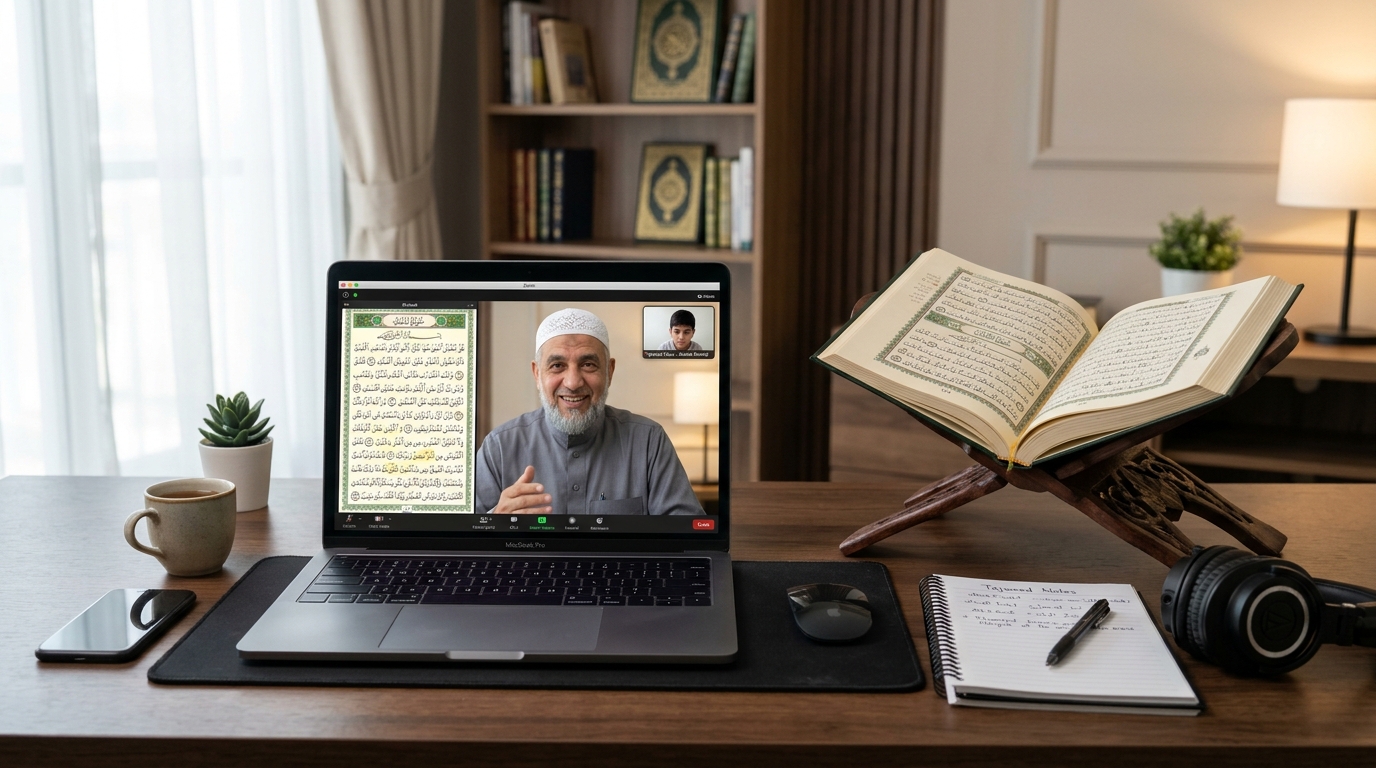
In our hyper-technological era, automated mobile applications, pre-recorded YouTube channels, and automated voice-recognition tools promise that anyone can learn the Holy Quran independently. While these digital tools have value as secondary review aids, Islamic scholarship has maintained an unbroken consensus for over 1,400 years: the Holy Quran cannot be mastered in isolation without a qualified human teacher. The Quran was transmitted orally through Talaqqi (face-to-face recitation from master to student), a sacred chain connecting every authentic reciter directly back to the Messenger of Allah ﷺ.
1. The Sacred Principle of Talaqqi & Musyafahah
The Arabic terms Talaqqi (direct reception) and Musyafahah (learning from the mouth of the scholar) represent the cornerstone of Quranic transmission. The Prophet Muhammad ﷺ did not receive the Quran as a written book dropped from heaven; he received it through oral recitation from the Angel Jibreel AS.A software algorithm cannot tell you whether the back of your tongue was elevated enough for the letter Qaf (ق), or whether your throat muscles contracted properly for Ayn (ع). Only a living, trained certified Quran tutor can listen with clinical auditory precision and correct subtle errors instantly.
2. Preventing Lahn Jali (Major Obvious Errors)
In Quranic recitation, mistakes are categorized into two types:- Lahn Jali (Clear/Major Mistake): Changing a vowel mark (Fatha to Damma) or confusing two phonetically close letters (such as pronouncing قلب 'heart' with a Kaf as كلب 'dog'). This alters divine meaning and is considered religiously sinful when done negligently.
- Lahn Khafi (Hidden/Minor Mistake): Omitting subtle Tajweed refinements such as shortening a 4-count Madd or neglecting the full nasal resonance (Ghunnah).
3. Human Accountability & Personalized Motivation
How many language-learning apps have you downloaded only to abandon them after three weeks? Self-paced study invariably succumbs to procrastination, work stress, and social distractions.The Human Mentorship Factor
When you have a dedicated 1-on-1 appointment with a teacher who knows your name, remembers your strengths, and cares about your spiritual progress, your commitment multiplies. A live teacher holds you accountable, reviews your homework, and adapts lesson pacing dynamically.
4. Cultural Sensitivity & Tailored Diaspora Scheduling
At Jamia Quran Academy, our tutors do not merely teach Arabic letters; they serve as spiritual mentors for children and adults navigating secular Western environments. Our 24/7 flexible scheduling ensures that whether you reside in New York, London, Toronto, or Sydney, your class happens exactly when you are most alert.The Concept of 'Sanad' & 'Ijazah': Why Certified Faculty Matters
In Islamic scholarship, the Holy Quran is not merely a written book that anyone can interpret at will; it is an oral tradition preserved through an unbroken divine chain of transmission called a Sanad (سَنَد).What is an Ijazah in Quran Recitation?
An Ijazah is a formal certification granted by an authorized master Qari confirming that the student has recited the entire Quran from memory or Mushaf with pristine Tajweed, tracing teacher-by-teacher directly back to the Prophet Muhammad ﷺ, who received it from the Angel Jibreel (AS), from Allah SWT.
The Psychological Danger of Learning Without a Teacher
Classical scholars frequently warned: 'Whoever takes only books as their teacher will make more errors than correct statements.' In modern times, this applies directly to learning Quran exclusively from automated apps or pre-recorded YouTube videos.While digital apps are helpful supplementary revision tools, they possess critical limitations:
- No Real-Time Error Correction: An app cannot hear if your tongue slipped from a soft Taa (ت) to an emphatic Taa (ط), which can fundamentally alter the Quranic meaning from 'repentance' to 'loss.'
- No Adaptation to Vocal Strain: An app cannot detect when a student is developing vocal fatigue or breathing incorrectly during long Ayahs.
- Lack of Spiritual Mentorship: A digital screen cannot inspire love for Allah, comfort a grieving student, or instill beautiful Islamic character (Adab).
Frequently Asked Questions
Q: Can I learn Quran Tajweed accurately just by using smartphone apps?
A: Apps are helpful for memorizing vocabulary or listening to reciters, but they cannot evaluate your mouth positioning, breathing control, or correct subtle pronunciation errors.
Q: What qualifications should I look for in an online Quran teacher?
A: Ensure the instructor holds an authentic Ijazah (Sanad chain), has formal Islamic university credentials (such as Dars-e-Nizami or Al-Azhar), is background-checked, and speaks fluent English.
Q: How does Jamia Quran Academy screen its teachers?
A: All our male and female instructors undergo rigorous multi-stage Quranic recitation tests, background vetting, and pedagogical training before teaching students.
Q: Are female Quran teachers available for sisters and young girls?
A: Yes. Jamia Quran Academy maintains a dedicated faculty of certified Alimahs and female Qariyahs who provide 1-on-1 lessons in complete privacy and modesty for female students worldwide.
Q: How does the tutor track my child's progress across lessons?
A: After every session, tutors log the student's completed verses, specific Tajweed challenges, and homework in our digital student portal. Monthly academic progress reports are shared directly with parents.
Jamia Quran Academy Scholarly Council
Authored and reviewed by certified Islamic educators and Ijazah-bearing Qaris at Jamia Quran Academy. Committed to spreading pure Quranic literacy, Tajweed, and character-building worldwide.
Begin Your Quranic Journey Today
Experience authentic 1-on-1 online classes tailored for children and adults. Start with 3 days of completely free evaluation sessions with our certified tutors.